
Types of Reactions in Organic Chemistry: Your Guide to Mastery
Discover key types of organic chemistry reactions, their mechanisms, and expert tips to master reactions for success in Organic Chemistry 1 and 2 courses.
Every organic chemistry problem comes down to one main idea—how molecules react. For many students, organic chemistry is full of tricky terms and steps. You might try to remember reaction names but without knowing why they happen, it can feel frustrating.
That is why learning the different types of reactions makes such a big difference. Once you understand how substitution, elimination, and addition reactions work, things start to click in your mind. This way, you will be able to predict what products will form and feel more confident in understanding Organic Chemistry.
In this guide, you’ll discover the fundamental mechanism of reaction in organic chemistry. We’ll break down the differences between substitution, elimination, addition reactions and other key categories.
Let’s dive in.
Why Understanding Reaction Mechanisms Is Key in Organic Chemistry
In organic chemistry, reactions happen when bonds between atoms break and new ones form. This is how new compounds are made—and it is also how many biological processes and medicines are created.
Instead of only memorizing reaction types, it is much more helpful to understand how these reactions actually work. This is what we call the reaction mechanism. It shows how electrons move, how temporary structures (called intermediates) form, and why certain products are formed.
A tool called curved-arrow notation helps you see how electrons shift during a reaction. It shows where nucleophiles (electron-rich parts) attack and how leaving groups (parts that break off) exit.
When you understand reaction mechanisms, you can predict how new reactions will go and figure out problems you have never seen before. This makes organic chemistry feel more logical and easier to learn.
What Are The Core Categories of Organic Chemistry Reactions
To simplify your learning, let us break down some of the common reactions in organic chemistry you will see most frequently.
Here is a quick review of all the important reactions:
1. Substitution Reactions

Substitution reactions happen when one atom or group in a molecule is swapped for a different one. These reactions often occur with alkyl halides.
- SN1 involves a two-step mechanism with a carbocation intermediate. It favors tertiary carbons and polar protic solvents.
- SN2 is a one-step concerted reaction. It is typical for primary carbons where the nucleophile attacks from the opposite side.
Example:
CH4 + Cl2 → CH3Cl + HCl
(Here, a chlorine atom substitutes one hydrogen atom in methane.)
Substitution reactions often happen alongside elimination reactions. Because of this, you will usually study substitution elimination and addition reactions together.
2. Elimination Reactions
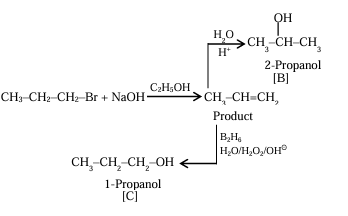
Elimination reactions take atoms away from a molecule to create double or triple bonds. The most common types are E1 and E2:
- E1 happens in two steps and forms a carbocation. It works in a way similar to SN1 reactions.
- E2 happens in one step. A base removes a proton at the same time a group leaves the molecule.
Example (E2)
CH3CH2Br + OH⁻ → CH2=CH2 + Br⁻ + H2O
(Here, a proton and bromide ion are eliminated to form ethene.)
Elimination reactions are different from substitution because they create double or triple bonds, called unsaturation. Due to this, addition and elimination reactions are often taught together.
3. Addition Reactions
Addition reactions add atoms or groups to a double or triple bond, turning unsaturated molecules into saturated ones. These reactions are common in alkenes and alkynes.
For example, when hydrogen halides (HX) are added to alkenes, the double bond breaks, and new single bonds form with hydrogen and halide atoms.
Example:
CH2=CH2 + HBr → CH3–CH2Br
(Hydrogen bromide adds across the ethene double bond.)
4. Rearrangement Reactions
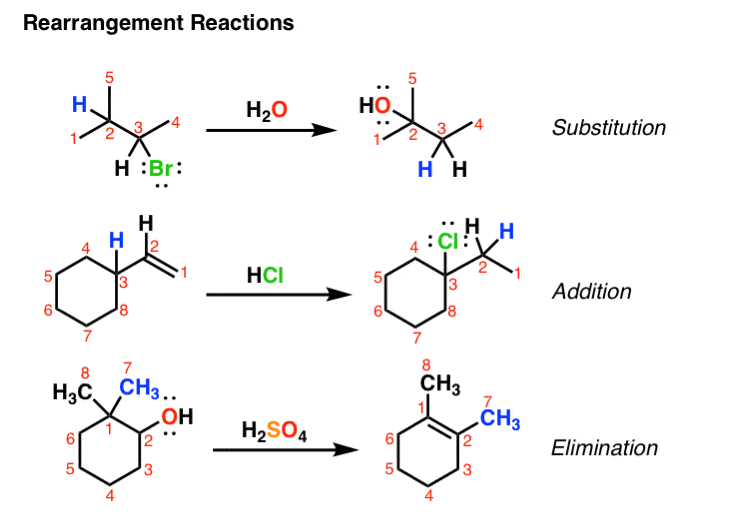
Rearrangement reactions occur when atoms or groups within a molecule rearrange to form a more stable structure.
A common example is carbocation rearrangement during SN1 or E1 reactions, which can change the products you get.
Example:
(CH3)3C⁺ → (CH3)2CH–CH3⁺
(Tert-butyl carbocation rearranges to isobutyl carbocation.)
5. Oxidation and Reduction Reactions
Oxidation means adding oxygen or losing hydrogen, while reduction is the opposite.
These changes are important for turning one functional group into another, like changing alcohols into aldehydes or ketones.
Example Oxidation:CH3CH2OH + [O] → CH3CHO + H2O(Ethanol oxidized to acetaldehyde.)Example Reduction:CH3CHO + 2[H] → CH3CH2OH(Acetaldehyde is reduced back to ethanol.)
6. Condensation and Hydrolysis Reactions
Condensation reactions join two molecules with the loss of a small molecule (usually water), which is important in forming esters or peptides. Hydrolysis breaks bonds by adding water and is vital in biochemical processes like protein digestion.
Condensation reactions join two molecules together while losing a small molecule, usually water. This process is important for making things like esters or peptides.
Hydrolysis is the opposite. It breaks bonds by adding water. Hydrolysis is very important in biological processes, like breaking down proteins during digestion.
Condensation Example:
CH3COOH + C2H5OH → CH3COOC2H5 + H2O
(Acid and alcohol form an ester and water.)
Hydrolysis Example:
CH3COOC2H5 + H2O → CH3COOH + C2H5OH
(Ester hydrolyzed back to acid and alcohol.)
7. Multistep Synthesis

Multistep synthesis in organic chemistry means using a series of reactions to make complex molecules from simpler ones.
For example, changing alcohol into an ester might take two steps: first, oxidation, then esterification. This step-by-step process is very important in advanced organic synthesis.
Example:
- CH3CH2OH + [O] → CH3CHO + H2O
- CH3CHO + C2H5OH → CH3CH(OCH2CH3) + H2O (Acetal formation)(Alcohol oxidized to aldehyde, then converted in the second step.)
Which Two Types of Organic Reactions Are Often Confused?
The two types of organic reactions are substitution and elimination which frequently compete under the same conditions.
- Substitution replaces one group with another.
- Elimination removes groups to form unsaturation.
Factors such as base strength, solvent type and substrate structure help determine which reaction predominates. For example, strong bases and heat often favor the elimination process.
Achieve Success in Organic Chemistry with Orango Learn Organic Chemistry with Clarity at Orango
Orango helps students like you learn organic chemistry with clear explanations and confidence. Our Organic Chemistry course comprises 13 modules that break down complex topics into easy-to-understand lessons.
You also get exam-style practice tests and support from a personal tutor. The best part is that you can try a free trial module before making a decision.
Orango’s step-by-step teaching method makes organic chemistry more straightforward to understand and handle.
Ready to master organic chemistry reactions? Sign up with Orango now and build a strong foundation.
Final Words
To sum up the discussion, mastering the basic types of organic chemistry reactions, such as substitution, elimination, and addition lays the groundwork for lasting success in the subject.
A clear understanding of these fundamentals helps you move beyond rote memorization, solve challenging problems, and approach advanced coursework with confidence.
With consistent practice and a solid grasp of mechanisms, you’ll be well-prepared for future achievements in STEM, pre-med, or any science-related field.
Ready to Get Started?
Sign Up for Online Chemistry Tutoring Today
Whether you need last-minute help or long-term guidance, our online chemistry tutors are here to support your journey. Join the students who’ve already found success with Orango’s expert-led online tutoring.
Take the first step today.Let’s make chemistry simple together.