
How to Master Conversion Factors in Chemistry with Simple Steps
Learn how to master conversion factors in chemistry with easy steps, metric conversion tables, and practical examples. Master unit conversions with confidence.
Accuracy in chemistry starts with getting units right. A small mistake in converting milliliters to liters or grams to kilograms can throw off an entire calculation or experiment. Mastering conversion factors in chemistry is essential for performing calculations quickly and confidently.
With the right approach, formulas, and visual aids, unit conversions become straightforward and reliable. This guide presents simple, step-by-step strategies that make conversions easy to understand, helping students focus on learning chemistry effectively and efficiently.
Understanding Unit Conversions in Chemistry

Unit conversions are fundamental in chemistry. They enable you to translate measurements from one unit to another. This skill is crucial when dealing with various units like grams, liters, and meters, ensuring consistency and accuracy in your calculations. If a lab requires 0.75 kilograms of a chemical but the balance shows grams, you need to convert 750 grams to 0.75 kg to use the correct amount.
What Are Unit Conversions?
Unit conversions involve changing a measurement from one unit to another while maintaining its value. This process is essential when different units are used in chemical equations or experiments.
Example: Suppose a chemical reaction requires 250 milliliters of water, but your measuring cylinder is marked in liters. You would convert 250 mL to 0.250 L to measure accurately.
What Are Conversion Factors in Chemistry?
A conversion factor is a ratio that expresses how many of one unit are equal to another. For example, the formula is simple
Quantity in desired units = Quantity in original units × Conversion factor
For example, to convert 5 kilometers to meters:
5 km × (1000 m / 1 km) = 5000 m
This means that 5 kilometers is equivalent to 5000 meters.
Why Mastering Conversion Factors Matters
Unit conversions are everywhere in chemistry. Labs, exams, and real-world applications all demand exact numbers. For example, converting 50 mL to liters is critical when preparing solutions. Using a consistent approach ensures your calculations are correct every time. Incorrect conversions can lead to failed experiments or calculation errors. Mastering these conversions allows you to:
- Solve problems faster
- Avoid unit mistakes
- Build confidence in your chemistry skills
- Apply knowledge across courses and exams
Metric Conversion Table & Chart for Chemistry
A metric conversion table in chemistry is your best friend. It lists units of mass, length, and volume along with their multiples and submultiples. Knowing this table allows you to perform metric conversions for chemistry with ease. You can quickly determine which conversion factor to apply. Here is a concise metric conversion chart for chemistry:
Step-by-Step Method to Convert Units in Chemistry
To confidently handle any chemistry calculation, it is important to follow a clear, systematic approach. The next section breaks down a step-by-step method to convert units in chemistry, making conversions accurate, consistent, and easy to follow.
Step 1: Identify the Given Quantity and Its Unit
Start by noting the quantity and its unit. For instance, if you have 50 milliliters (mL), write it as:
50mL
Step 2: Determine the Desired Unit
Decide on the unit you want to convert to. In this case, let's convert milliliters to liters (L).
Step 3: Use the Appropriate Conversion Factor
Select the conversion factor that relates the given unit to the desired unit. For milliliters to liters:
1L=1000mL
Therefore, the conversion factor is:
Step 4: Set Up the Conversion Equation
Multiply the given quantity by the conversion factor, ensuring that units cancel appropriately:
Step 5: Perform the Calculation
After canceling the units, perform the multiplication:
Thus, 50 milliliters is equal to 0.050 liters.
Essential Chemistry Unit Conversion Table with Examples
To make unit conversions even easier, the table below provides a complete reference with conversion factors and example calculations for all essential measurements in chemistry.
Practice Problem
Let's apply this knowledge to a practical example:

Additional Examples
Example 1: Convert 5000 milligrams to grams
Solution:

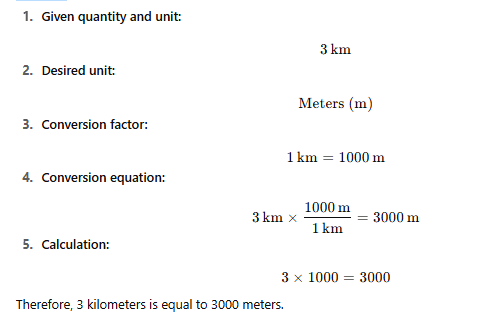
Example 2: Convert 3 kilometers to meters
Solution:
Tips to Master Conversion Factors Quickly
- Practice with worked problems daily
- Use a step-by-step approach consistently
- Take advantage of interactive quizzes and worksheets
- Memorize metric prefixes and conversion factors
- Break complex conversions into smaller steps
How Orango Helps You Learn Organic Chemistry
Orango provides a structured learning path designed specifically for students tackling chemistry. Our 13-module Organic Chemistry course covers both fundamental concepts and applied practice.
Students can reinforce their learning through practice sets with step-by-step solutions, allowing them to grasp each concept thoroughly.
For additional support, Orango offers personalized help through Ask-a-Tutor and Orango Live, so you can get your doubts clarified in real time.
Conclusion
Conversion factors in chemistry are not complicated when approached systematically. Use metric conversion tables and charts, follow step-by-step methods, and practice with real problems. With consistent effort, you can solve unit conversions for chemistry confidently, prepare accurately for exams, and excel in lab work.
Start with small examples, track your progress, and leverage structured tools like Orango to enhance your learning. Mastering these conversions sets a strong foundation for your chemistry journey.
Ready to Get Started?
Sign Up for Online Chemistry Tutoring Today
Whether you need last-minute help or long-term guidance, our online chemistry tutors are here to support your journey. Join the students who’ve already found success with Orango’s expert-led online tutoring.
Take the first step today.Let’s make chemistry simple together.