
Primary, Secondary, Tertiary, Quaternary in Organic Chemistry – A Student’s Guide to Carbon Classifications
Learn how to accurately identify primary, secondary, tertiary carbons with real-world examples, structural formulas, and step-by-step explanations.
Every organic molecule starts with one core element: carbon. But not all carbons function in the same manner. Some atoms connect to just one other carbon while others are linked to two, three, or even four.
These differences may seem small, but they affect how molecules react and how they are named. That is why knowing how to spot primary, secondary, tertiary, and quaternary carbons is a key skill in organic chemistry.
In this guide, you will learn exactly how to identify these types of carbons and why this classification matters in reactions, mechanisms, and functional groups.
What Do Primary, Secondary, Tertiary, and Quaternary Mean?
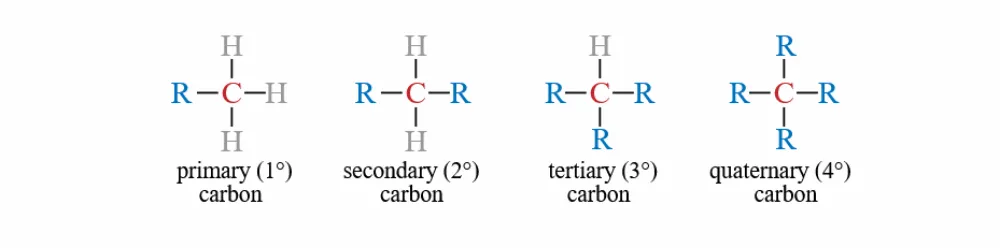
In organic chemistry, carbon atoms are often grouped by how many other carbon atoms they are bonded to. This is known as their degree of substitution. Here is a quick breakdown:
What is a Primary Carbon?
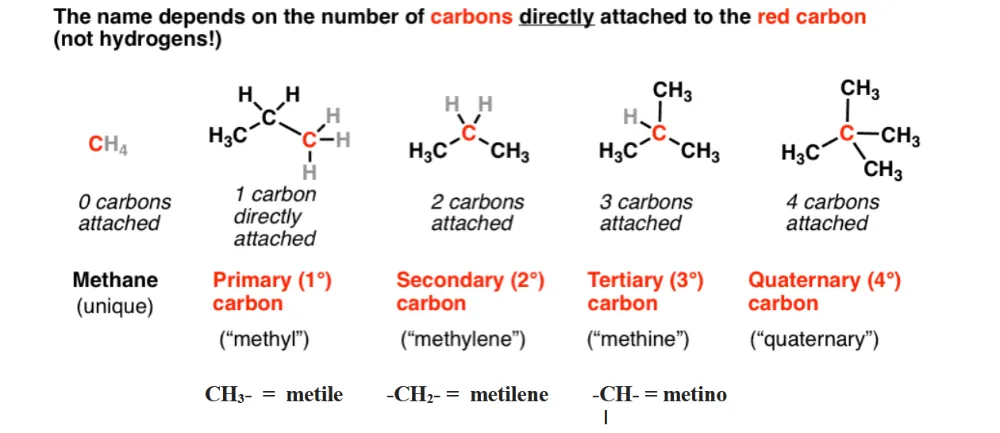
A primary carbon is bonded to only one other carbon atom. It also carries three hydrogen atoms. You can recognize it in structures like CH₃–CH₂– (ethyl group), where the CH₂ is directly attached to one carbon. This type of carbon is referred to as a “methyl” carbon.
What is a Secondary Carbon?
A secondary carbon is bonded to two other carbon atoms and has two hydrogen atoms. A common example is the middle carbon in CH₃–CH₂–CH₃ (propane), where the CH₂ is sandwiched between two CH₃ groups. This carbon is referred to as a “methylene” carbon.
What is a Tertiary Carbon?
A tertiary carbon is connected to three other carbon atoms and holds one hydrogen. It appears in branched molecules like (CH₃)₃C–H, where the central carbon is surrounded by three methyl groups. This is known as a “methine” carbon.
What is a Quaternary Carbon?
A quaternary carbon is fully bonded to four other carbon atoms and does not have any hydrogens. A classic example is (CH₃)₄C, where the central carbon is surrounded by four methyl groups. This type of carbon is often found in bulky, highly branched compounds and is simply called a “quaternary” carbon.
Understanding Primary, Secondary, Tertiary Carbons with Real Examples
Let us take a closer look at real molecules:
- Ethane (CH₃–CH₃): Both carbons are primary. Each is bonded to only one carbon.
- Propane (CH₃–CH₂–CH₃): The middle carbon is secondary, while the two end carbons are primary.
- Isobutane ((CH₃)₃CH): The central carbon is tertiary, and all three CH₃ groups are primary.
Branched molecules like isobutane or neopentane are excellent for spotting tertiary and quaternary carbons. These structures are common in exam questions because they test your ability to classify without relying on a straight chain.
How Carbon Classification Applies to Functional Groups
Functional groups are often named based on the type of carbon or atom to which they are bonded. This affects how the molecule reacts, especially in oxidation, substitution, and elimination processes.
Study Tip:Always count carbon atoms directly bonded to the target atom (C or N). Ignore hydrogens, halogens, or hydroxyls during classification. These functional groups follow the primary, secondary, and tertiary carbon rule.
What Are Primary, Secondary, and Tertiary Hydrogens?
Each hydrogen atom is named based on the type of carbon to which it is attached. This is especially important when studying reactions involving radical formation, substitution, or hydrogen abstraction.
Here is how it works:
- Primary Hydrogen
- Attached to a primary carbon
- Found in –CH₃ groups (like in ethane or the ends of a carbon chain)
- Secondary Hydrogen
- Connected to a secondary carbon
- Found in –CH₂– groups that link two other carbons (like in propane)
- Tertiary Hydrogen
- Bonded to a tertiary carbon
- Found on a carbon connected to three other carbon atoms (like in isobutane)
Carbon Classification Errors to Watch Out For
You may be confident with the rules, but it is easy to slip up. Watch out for the following mistakes:
- Miscounting carbon atoms
- Tip: Only count direct carbon neighbors—not hydrogens or other atoms.
- Applying terms to aromatic or sp² carbons
- Tip: These labels apply only to sp³-hybridized carbons (alkyl groups).
- Calling methane a “primary carbon”
- Tip: Methane (CH₄) has no carbon neighbors, so it is not classified as primary, secondary, or tertiary.
- Overlooking branches in molecules
- Tip: Always draw skeletal structures or visualize connections to see carbon relationships clearly.
Practice Time: Identify These primary, Secondary, Tertiary Carbons
1. CH₃–CH₂–CH₂–CH₃
What types of carbon atoms are present in this straight-chain alkane?
2. (CH₃)₃C–CH₂–CH₃
Identify the central carbon and other carbon types in this branched alkane.
3. CH₃–CH(OH)–CH₃
What type of alcohol is this? Classify the carbon bearing the –OH group.
4. CH₃–CH₂–CHBr–CH₃
What kind of alkyl halide is this? Identify the carbon bonded to Br.
5. CH₃–CH₂–CH₃
In this molecule (propane), what type of carbons are at the ends and in the middle?
6. CH₃–CH₂–CH₂Cl
Classify the carbon that holds the halogen atom.
7. CH₃–C(CH₃)₂–CH₃
What type of carbon is at the center? What about the CH₃ groups?
8. CH₃–CH₂–CH(OH)–CH₃
What type of alcohol is this? What is the substitution level of the carbon with –OH?
9. (CH₃)₃C–Br
Is this a primary, secondary, or tertiary alkyl halide?
10. (CH₃)₄C
Classify the central carbon in this compact, branched molecule.
Answer Key
Final Words
In the end, knowing how to classify primary, secondary, and tertiary carbons builds your foundation for naming, predicting mechanisms, and excelling in problem-solving. It helps you recognize patterns more quickly, avoid common mistakes, and apply the correct strategy when tackling exam questions. Mastering this early gives you a huge advantage as the course material becomes more complex.
Ready to get ahead? Try Orango’s 13-module Organic Chemistry Semester 1 course today. It includes step-by-step practice problems, searchable video lessons, and on-demand tutor help. You will not only reinforce core concepts but also build real confidence in your ability to apply them. Learn smart. Learn fast. Learn with confidence.
Ready to Get Started?
Sign Up for Online Chemistry Tutoring Today
Whether you need last-minute help or long-term guidance, our online chemistry tutors are here to support your journey. Join the students who’ve already found success with Orango’s expert-led online tutoring.
Take the first step today.Let’s make chemistry simple together.